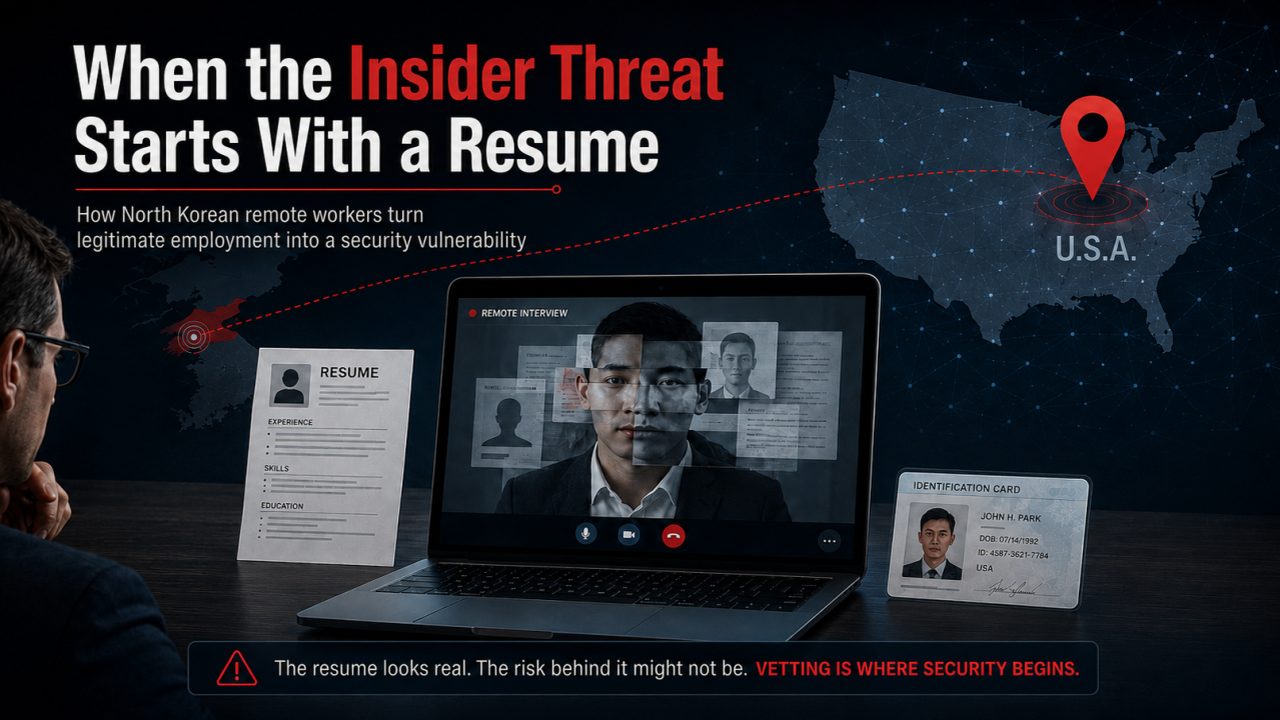
For years, the North Korean government has deployed technically skilled workers abroad and online to obtain employment with Western companies while concealing their identities, nationality, and true location. They use stolen or fabricated identities, false employment histories, proxy infrastructure, U.S.-based facilitators, and increasingly sophisticated methods to fraudulently obtain remote work positions.
The main objective of this activity is to generate money for government coffers. Since North Korea is heavily sanctioned, it uses these workers to generate income to support the regime. The U.S. government assesses substantial portions of these earnings are used to support national priorities, including weapons of mass destruction and ballistic missile programs.
A 2024 United Nations Panel of Experts estimate cited by the U.S. Department of Justice assessed that approximately 3,000 North Korean IT workers were operating overseas, with another 1,000 working from inside North Korea, generating an estimated $250 million to $600 million annually for the regime.
Tech companies remain the most visible targets, particularly those hiring remote software developers. However, tech companies are only about half of the targeted organizations. North Korea targets a wide array of industries, including finance, healthcare, and professional services.
A company's industry does not define the risk exposure. Rather, a combination of remote hiring, inadequate identity verification, and potentially insufficient monitoring of employee activity increases the risk of falling victim to this scheme. North Korea is taking advantage of a hiring system which has evolved over decades with no consideration for this type of risk. The days of only conducting I-9 verifications are over.
To examine this threat, Blue Lantern Advisory and OUTFOXM bring together complementary perspectives on investigative capacity building and organizational cyber readiness. Together, we examine how organizations can prevent and detect fraudulent remote workers, as well as prepare for the possibility that one successfully gains access.
How the Scheme Works
North Korea's remote worker strategy relies less on technical intrusion than on deception. North Korean workers seek employment while concealing their nationality, location and affiliations with the assistance of U.S.-based facilitators.
They commonly use stolen or fabricated identities, falsified resumes and credentials as well as fake social media profiles and online portfolios to present themselves as U.S. or non-North Korean workers. In some cases they use U.S.-based facilitators to establish domestic internet connections, create bank accounts, and receive company-issued laptops. A single worker may operate multiple identities, while identities and accounts may also be shared among members of a team.
The Role of U.S.-Based Facilitators
U.S.-based facilitators help North Korea's workers overcome one of the scheme's central challenges: making an overseas worker appear to be physically located in the United States. Facilitators may receive company-issued laptops at U.S. addresses, connect those devices to remote-access hardware or software, and provide domestic internet infrastructure that allows overseas workers to access employer networks while appearing U.S.-based. Some also establish bank accounts, create job-platform accounts or front businesses, receive payroll funds, reship equipment overseas, or participate in employer screening and interviews.
These arrangements, sometimes described as "laptop farms," can defeat controls intended to identify foreign applicants or block overseas access. Recent Department of Justice cases demonstrate that facilitators have supported North Korean workers across hundreds of U.S. companies, providing the physical and financial infrastructure needed to sustain fraudulent employment and transfer proceeds overseas.
Traditional practices are not sufficient to detect this style of fraud in the recruitment process. Organizations should treat identity verification as part of an investigative process rather than an administrative check.
Candidate Vetting
Organizations should:
- Conduct a stringent, formal pre-employment background check
- Independently verify documents submitted as part of the application; scrutinize documents for alteration or forgery
- Compare names, claimed location, contact details, educational history, employment history, and other biographical information across resumes, social media profiles, portfolio websites, and other available sources
- Use phone-carrier lookup tools to identify Voice over Internet Protocol numbers or other anomalies associated with candidates and references
- Examine portfolio work to determine whether claimed projects have been copied or cloned from legitimate individuals
During Interviews
Fraudulent candidates may perform well during an interview. The candidate may possess the required technical skills and speak fluent English, or use artificial intelligence to assist with the language barrier. Interviewers should not exclusively focus on technical competencies, but holistically confirm whether the candidate is who they claim to be. Remote interviews should include identity verification measures.
Organizations should consider:
- Requiring video-on interviews and asking candidates to disable background blurring, virtual backgrounds, and visual filters
- Comparing the individual on camera with submitted identification
- Capturing a reference image so the person appearing in subsequent interviews and during employment can be compared with the original candidate
- When concerns arise, testing the candidate's claimed location through contextual questions or by asking them to demonstrate their surroundings
- Using simple movements during video calls that may expose manipulated video
- Incorporating creative interviewing techniques designed to test whether the candidate possesses the lived experience implied by the identity and history they have presented
Case Study: Creative Interviewing at Kraken
When cryptocurrency exchange Kraken suspected a software engineering applicant was a North Korean operative, its security team used creative interviewing techniques to test whether his claimed background was genuine. The applicant said he had attended New York University and lived in Houston. During an interview scheduled on Halloween, he appeared unfamiliar with basic Halloween traditions and could not answer simple questions about restaurants or daily life in Houston. The exercise demonstrated how conversational questions about local culture and personal experience can expose inconsistencies that technical interviews and résumé reviews may miss.
During Onboarding
Verification should not end once a job offer is extended to the candidate. Additional indicators of fraudulent candidates can manifest during the onboarding process.
Organizations should:
- Check for bank account information inconsistent with the identity characteristics or locations associated with the application; avoid payments in cryptocurrency to freelance workers
- Require shipment of company equipment to only the address listed on the application, and require photo identification to accept company equipment from freight forwarders
- Treat changes to address or bank account information during onboarding as suspicious
- If possible, perform onboarding in person
During Employment
Once hired, the employee may perform enough legitimate work to maintain employment and continue receiving a salary. While the employee may present as genuinely productive, behind the scenes they may use artificial intelligence tools, rely on third-party facilitators, or subcontract portions of their work to other individuals to help sustain the deception and meet job requirements. Wages are ultimately transferred through intermediaries to the North Korean regime.
The greatest security concern begins after hiring, because the employee, who has entered through legitimate channels, may voluntarily be granted credentials, company devices, network access and other sensitive resources. In effect, the scheme converts a fraudulent applicant into a trusted insider.
Organizations should:
- Conduct frequent, video-on employee check-ins and use the captured reference image from the interview to validate the employee is the same individual interviewed
- Block applications not controlled enterprise-wide
- Monitor for unusual geographic logins, VPN usage, off-hours activity, large data downloads, credential sharing, and access inconsistent with the employee's responsibilities
- Monitor for KVM (Keyboard, Video, Mouse) devices, an indication of maintaining persistent remote access to devices, and prolonged video conferencing sessions, an indication of receiving third-party instructions
- Disable or tightly control remote-desktop and remote-collaboration applications on company equipment where they are not required
- Screen for the deployment of malware, such as InvisibleFerret, BeaverTail or OtterCookie, known to be used by North Korea (a comprehensive list of malware used by North Korean actors can be found through MITRE ATT&CK)
Case Study: Endpoint Security Discovery at KnowBe4
In 2024, cybersecurity company KnowBe4 inadvertently hired a North Korean IT worker as a software engineer after the candidate passed multiple video interviews, reference checks, and a background check using a stolen U.S. identity. The deception was discovered only after the employee received a company laptop and attempted to execute unauthorized software and transfer potentially malicious files. Endpoint security alerted KnowBe4's security operations center, which contained the device within approximately 25 minutes. A subsequent investigation involving the FBI identified the employee as a North Korean IT worker. No company or customer data was compromised.
No individual control is sufficient if recruiters, hiring managers, onboarding personnel, and security teams do not understand the threat they are trying to detect. Organizations should train personnel involved in hiring and onboarding to recognize common indicators associated with the North Korean remote worker scheme, understand when inconsistencies warrant additional scrutiny, and know how to escalate concerns to security or legal personnel. Training should emphasize that no single indicator is determinative. The objective is to identify patterns of inconsistency that may justify further verification.
Preparing for Controls to Fail
No mitigation plan is one hundred percent foolproof. Therefore, in addition to the steps above, we also recommend all organizations make a concerted effort to plan for the worst. That is, plan for a scenario in which a malicious remote worker is hired and granted access to your networks and systems, despite best efforts to prevent it. These individuals, and the nation states often behind them, are skilled at manipulation, impersonation and espionage, and only have to succeed once.
The recommendations that follow all center around predetermining key response actions and responsibilities so that in a real-world emergency, much of the hard work is already done.
- Pre-decide roles and escalation paths. If a suspected fraudulent employee is identified, what is the escalation path for that information? Who needs to be notified internally, and under what circumstances should external parties be engaged?
- Define decision authorities. Security, IT, HR, Legal, Finance and leadership may all need to act quickly and in coordination. Determine in advance who is responsible for key decisions, such as monitoring the suspected employee, restricting or terminating access, engaging law enforcement, and notifying executive leadership or the Board.
- Plan for the monitor-or-act decision. Organizations may face a tradeoff between continuing to monitor an insider threat to gather information versus restricting their access to limit potential harm. Discuss this tradeoff ahead of time, including who has authority to make the decision and what factors should inform it.
- Rehearse the scenario. Use a short tabletop or wargame to test assumptions, handoffs, escalation paths and key decisions before facing a genuine situation.
Conclusion
The central lesson is straightforward: identity verification does not end when an employee is hired.
Organizations that hire remote workers should independently validate identity and history, test inconsistencies during interviews, scrutinize changes during onboarding, limit access after hiring, and continue verifying that the person using company credentials is the person the organization intended to hire.
But even strong preventative and detection measures can fail. Organizations should also prepare for the possibility that a fraudulent worker compromises the system by deciding key roles and decision authorities ahead of time, and rehearse realistic scenarios. The goal is not only to reduce the likelihood of a bad actor gaining access, but to ensure the organization is ready if one does.